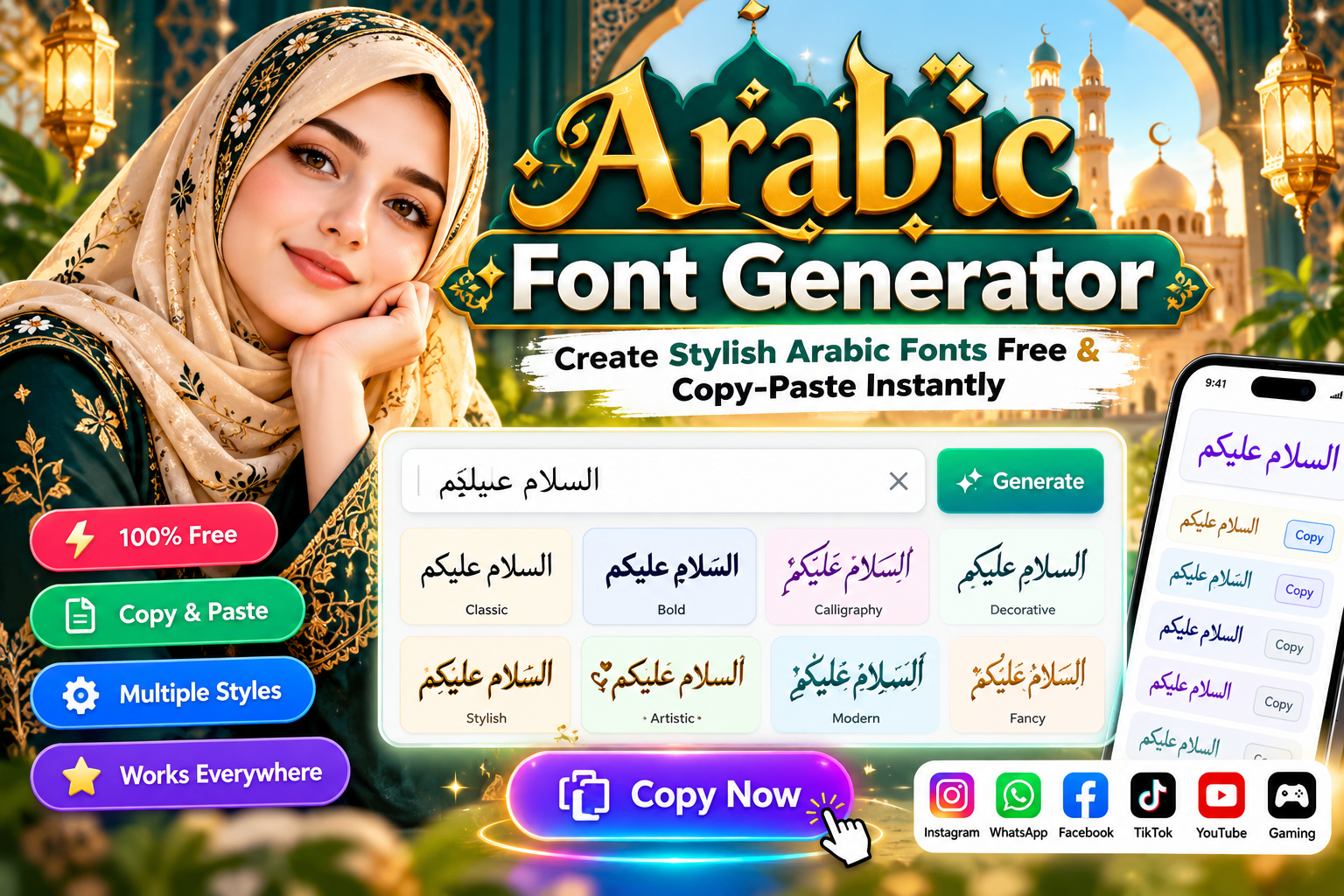

مولد الخطوط العربية والزخرفة
اكتب نصك واستعرضه بتشكيلة واسعة من الخطوط العربية الأصيلة والحديثة
An Arabic font generator transforms Arabic text into distinctive Arabic typography styles, combining calligraphy styles with creative direction for social media, branding, and design purposes while retaining standard text where readability matters most across platforms.
From testing multiple styles, I find these tools suit modern Arabic fonts, traditional calligraphy, decorative options, Instagram, TikTok, logos, websites, wedding invitations, Eid, Ramadan cards, and profile images when Arabic letters matter online today.
Table of Contents
What Is An Arabic Font Generator?
An online tool turns entered text into varied font styles, helping users inspect Arabic typography without installing software. I’ve found this useful when testing calligraphy options quickly before selecting a style for design projects digitally.
The generator is more than decoration: it can support creative purposes, social profiles, branding, and study materials by showing how Arabic script changes visually. The preview stage makes comparisons easier before sharing or exporting text.
Also Read: Fontes Aesthetic
Why Use An Arabic Font Generator?
I recommend an online Arabic font generator when speed matters: live previews, customization, and a broad font library let you test Arabic typography without mastering software or advanced drawing techniques first for everyday creative work.
It also supports practical accessibility and efficiency: right-to-left direction, ordinary text, and downloadable designs make experiments easier for branding, posts, study materials, or personal projects while keeping Arabic visuals consistent across uses and visually flexible.
How To Use An Arabic Font Generator
I usually judge the finished look before touching settings: preview the text, compare Naskh, Kufic, and Diwani, then enter text through direct Arabic typing or copy-paste input after browsing font collections for the character behavior.
In my checks, alignment and correct RTL handling matter before decoration; adjust font size, text color, and background color, verify across devices, then use the copy function, styled text, or PNG download for final delivery.
Arabic Font Styles And Categories
I usually begin with traditional fonts, where flowing calligraphic writing preserves classical calligraphy styles and supports Islamic culture. Then I compare modern fonts, whose cleaner shapes suit readable digital experiences and contemporary screens carefully today.
For practical projects, I group choices into Arabic calligraphy, Kufi, historic scripts, and modern Arabic typography. This range helps designers match contemporary projects, logos, interfaces, and social artwork without losing Arabic script character visually today.
Arabic Calligraphy And Its Cultural Background
Arabic calligraphy grew as cultural art, carrying language, faith, and identity through generations. Classical calligraphy styles shaped manuscripts, while Thuluth gained prominence in inscriptions and Islamic-themed artwork, preserving historical memory through carefully balanced letterforms today.
Later, Ruq’ah and traditional Arabic typography broadened everyday expression. Middle Eastern, Islamic, and Arab-culture-inspired font styles still influence Arabic fonts, while mosque-related aesthetics and religious designs connect lettering with enduring heritage in contemporary visual practice.
Arabic Typography: Traditional Vs. Modern
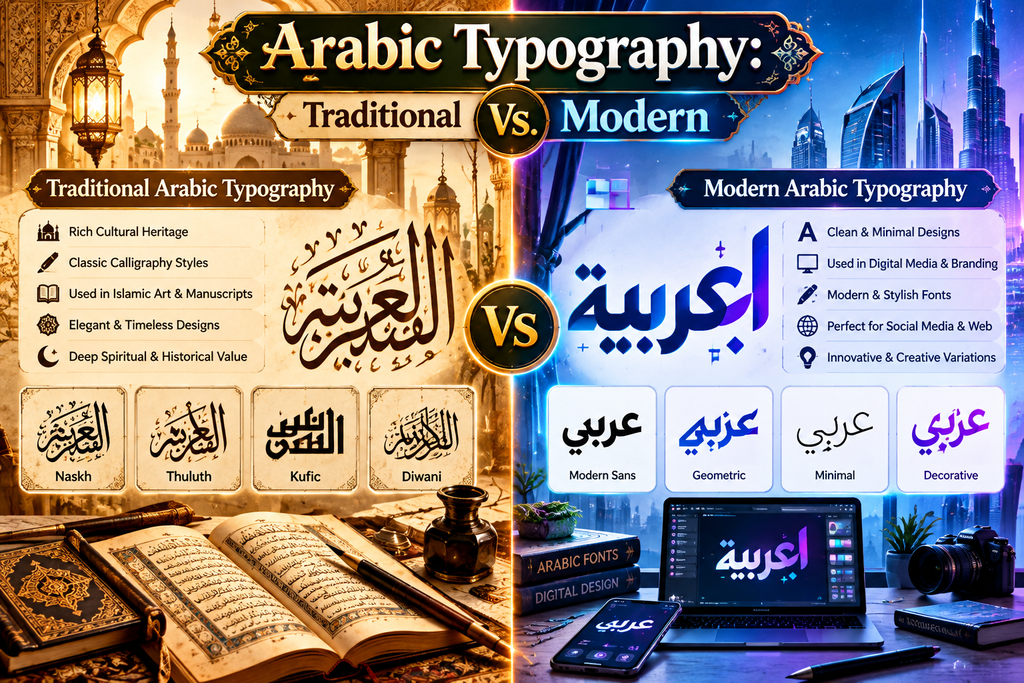
Digital lettering begins with Arabic script but departs from traditional writing practices, using modern fonts to shape visual designs for screens. In practice, I compare readable font sizes, ligatures, and diacritics before choosing one precisely.
Heritage work still rewards skilled calligraphers, especially when historical purposes influence lettercraft; contemporary systems prioritize speed, experimentation, and browser testing across device testing. Layouts respect history while adapting regional usage and bilingual Arabic-Latin typography online.
Arabic Font Customization Options
In my testing, the most useful customization starts with font size, then customize font choices that keep Arabic shaping readable. I compare colors, spacing, and backgrounds before selecting a polished finished result for immediate publishing.
A practical setup can combine preset backgrounds, transparent options, and gradients for different moods, while modern font formats help maintain consistent rendering. For branding, I also test stylish Arabic fonts against simple text design layouts.
Where Can You Use Arabic Fonts?
Arabic fonts become useful wherever written identity meets visual presentation, from social platforms and Instagram bios to logo creation and brand identity. For websites, RTL layouts keep directional behavior readable across modern digital interfaces today.
I recommend testing text in contrasting settings: social content, website headers, business cards, and presentations. For religious work, Ramadan greetings and Eid cards suit polished typography, while tattoos need tattoo designs and stylized Arabic typography.
Arabic Fonts For Social Media
Arabic fonts can make social-media use feel more distinctive when readability remains primary. I often pair clean letterforms with social posts, especially when online images need consistent identity across profiles, stories, and short campaigns daily.
Rather than treating decoration as the goal, use graphic design principles, business branding, and name art selectively; a balanced Arabic style can support embedded visual content, wallpapers, and platform-specific posts without overwhelming the message itself.
Arabic Fonts For Logos And Branding
For logos, I compare graphic design options with Arabic calligraphic styles and modern fonts, keeping recognition ahead of decoration. Exploring 100+ Arabic fonts reveals distinctive letter shapes, spacing, and proportions that support memorable brand identities.
TTF supports editing and repeated design work, while transparent PNG suits presentations. For paid projects, verify commercial use, individual font licenses, and licensing conditions before delivery. This distinction keeps brand assets reusable, consistent, and documented.
Arabic Fonts For Websites And Digital Interfaces
For websites, I treat Arabic branding as a readability decision first, not decoration. Clean letter spacing, sensible hierarchy, and restrained styling keep navigation, landing pages, and headers usable across screens, browsers, and interfaces without confusion.
In my workflow, text graphics work best when typography supports interaction rather than competing with it. Thoughtful graphic design keeps headings, buttons, menus, and forms recognizable, even when content expands, contracts, or shifts across screens.
Arabic Text: Right-To-Left And Character Behavior
Arabic text behaves differently because RTL configuration controls reading direction, while contextual letter forms adapt nearby characters. From my testing, connected writing and clear spacing matter more than decorative styling when preserving natural Arabic flow.
For websites, modern webfont formats improve rendering consistency, but browser compatibility still deserves attention. Proper Arabic line heights keep stacked lines readable, especially when standard glyph shaping, punctuation, and mixed-language content appear together consistently today.
Tips For Getting Better Arabic Font Results
For cleaner results, choose Arabic text with clear 28 standard letters, check right-to-left behavior, and test contextual letter forms across positions. Previewing visual appearance helps catch spacing, joins, and readability before copying or exporting it.
I usually compare selected font styles, then adjust outline, fill, and opacity while testing image dimensions. For repeated work, save a TTF version; for quick sharing, use finished image output and inspect mobile readability carefully.
Arabic Font Library And Font Search
An effective Arabic font library becomes useful when font exploration goes beyond browsing. I search by script behavior, density, and purpose, then compare wide collection options before choosing a style that remains readable and distinctive.
A font search process considers downloadable TTF fonts, licensing, and platform needs. When testing Arabic typography, I look for previews, reusable installed font format, and rendering across Microsoft Word, Adobe Photoshop, social platforms, and browsers.
English To Arabic Input
English-to-Arabic input is practical when users begin with familiar English letters, then apply conversion to produce readable Arabic script. A generator can offer suggestions, helping writers test phrasing before styling the final result accurately online.
For quick workflows, direct input is useful when Arabic typing is unavailable. I often recommend checking the generated script against the intended meaning, because stylistic conversion changes appearance, while language accuracy still depends on context.
Custom Backgrounds For Arabic Designs
Custom backgrounds can change how Arabic lettering reads before any font is adjusted. I often test soft gradients, textured patterns, or preset backgrounds first, because each choice affects contrast, spacing, and visual hierarchy with balance.
For polished Arabic designs, custom background images offer more control across posters, social posts, and branded artwork. Transparent backgrounds, subtle effects, and thoughtful layering help preserve clarity while giving decorative typography a distinctive setting consistently.
Arabic Fonts In Word And Photoshop
Microsoft Word and Photoshop handle Arabic fonts differently, yet both benefit from TTF downloads, proper install, and reliable font support. Check licensing before commercial projects, especially when sharing editable files across teams or clients.
For repeated production, keep the installed font available and test editing after opening the document. This saves repeated design work, while reused styles remain consistent between Word layouts, Photoshop layers, exported graphics, and future revisions.
Arabic Fonts, Persian And Urdu
In practice, designers install Arabic fonts when they need consistent shaping in Word or Photoshop, especially for Persian and Urdu text, where glyph coverage, joining behavior, and script-specific support can affect final layouts and previews.
A useful distinction is that Arabic-derived scripts share structural principles, yet Persian and Urdu may require additional characters and contextual forms. Testing real sentences helps reveal spacing issues before exporting or publishing finished designs online successfully.
Arabic Font Licensing And Commercial Use
Licensing should be checked before commercial publication because a visually appealing Arabic font may have restrictions. Review whether free access covers individual fonts, downloadable fonts, client work, advertising, packaging, or resale, and keep license records.
For professional projects, distinguish between generated text and artwork, then verify each typeface license separately. In my workflow, I document source, usage rights, attribution requirements, modification permissions, and redistribution limits before final delivery with confidence.
Arabic Font Generator For Tattoos
For tattoo lettering, an online tool helps test typographic styles before ink. I usually compare Arabic fonts with decorative effects, checking how each character connects and remains readable at real skin size for your tattoos.
For tattoo concepts, begin by testing multiple styles, checking suitable text lengths and contrasting colors; then review text settings beside skin placement before approving the final artwork. This helps prevent cramped details, preserving character clarity.
Also Read: Underline Text Generator
Arabic Fonts For Islamic And Religious Designs
Religious design rarely benefits from excessive decoration. In my projects, I favor Islamic-style typography with Quranic details, specialized typography, and carefully spaced Arabic designs, especially for educational projects and creative projects, where readability matters most.
Instead of copying a classical look, test calligraphy-focused font collections against text graphics and custom image backgrounds. I emphasize comparing fonts and testing across devices, finalize Arabic-styled text, ensuring spacing, hierarchy, and reverence stay intact.
Conclusion
A practical free tool can turn Arabic lettering into creative designs without demanding advanced software. I focus on clear previews, balanced spacing, and font exploration, because readable Arabic styling usually matters more than decoration alone.
Before publishing, compare different styles, keep personal use licensing notes visible, and prioritize testing across browsers. In my experience, careful font searching and selecting suitable forms produce cleaner results across social posts, branding, and interfaces.
What Is An Arabic Font Generator?
An Arabic font generator creates expressive lettering without requiring advanced design skills, giving users a practical way to test Arabic-style typography for names, headings, posters, interfaces, and social graphics before choosing a final treatment confidently.
What Is An Arabic Font Generator?
An Arabic font generator is a browser-based tool converting Arabic input into generated styles, letting users customize appearance around a finished design. It supports attractive Arabic typography for social media, branding, education, and design projects.
What Is An Arabic Font Generator?
An Arabic font generator is an online styling tool that transforms Arabic writing into varied typefaces, with support for Persian, Urdu, a selected font, and required characters. It simplifies four-step process workflows across online generators.
How Does An Arabic Font Generator Work?
An Arabic font generator interprets enter Arabic text, maps characters through Unicode rules, then renders connected writing according to the font. I usually check letter position, spacing, browser behavior, and readability before copying results.
How Do I Copy And Paste Arabic Fonts?
Arabic font generators are designed for a quick workflow: enter your phrase, choose a suitable design, inspect the result, and copy the finished characters. I recommend pasting them into your target platform to confirm appearance.


[…] Also Read: Arabic Font Generator […]